Digital minimalism on your phone means deciding which technology has earned a place on it, then removing everything else. Not a fast, not a detox, not a fixed number of days — a standing rule about what gets to be there at all. The 30-day declutter below is how you find out what passes it.
That is what separates it from the neighbouring ideas. A dopamine detox is about overstimulation and the reward system; a social media break is one category of app for a fixed stretch. Digital minimalism is the question you keep asking afterwards.
Popularized by Cal Newport in his 2019 book Digital Minimalism: Choosing a Focused Life in a Noisy World, the concept has evolved significantly since then. In 2026, digital minimalism is no longer a niche lifestyle choice — it is a growing movement embraced by millions who have experienced the burnout and anxiety that comes from an unmanaged digital life.
This comprehensive guide will walk you through everything you need to know about digital minimalism: what it is, why it matters, and exactly how to implement it in your life starting today.
What Is Digital Minimalism?
Digital minimalism is a philosophy of technology use in which you focus your online time on a small number of carefully selected and optimized activities that strongly support things you value, and then happily miss out on everything else. It is not anti-technology. It is pro-intention.
The core principle is that less can be more. Instead of mindlessly adopting every new app, platform, and service, digital minimalists ask a simple question: does this technology serve my deeply held values, or does it merely fill time? If it does not serve a clear purpose, it goes.
The Three Principles of Digital Minimalism
Why Digital Minimalism Matters in 2026
The case for digital minimalism has never been stronger. The average person spends over 4.5 hours daily on their smartphone, checks it 144 times per day, and has 80+ apps installed (using only about 9 regularly). Social media platforms have become more sophisticated in their attention-capture mechanisms, AI-generated content has flooded every platform, and the boundaries between work and personal digital life have all but dissolved.
The mental health consequences are well-documented: increased anxiety, depression, sleep disruption, shortened attention spans, and a pervasive sense of being overwhelmed. Many people report feeling like they are constantly behind, always reacting, never truly present. Digital minimalism addresses these symptoms at their root.
The Attention Economy
Understanding digital minimalism requires understanding what you are up against. Every free app and platform is part of the attention economy — a system where your attention is the product being sold to advertisers. These companies employ teams of psychologists, neuroscientists, and AI engineers to make their products as addictive as possible.
Infinite scroll, pull-to-refresh, variable reward schedules, social validation metrics, FOMO-inducing notifications — none of these features exist to serve you. They exist to keep you engaged so the platform can sell more ads. Digital minimalism is, at its core, a refusal to participate in this exploitation of your attention.
You Are the Product
The 30-Day Digital Declutter
Cal Newport’s recommended starting point for digital minimalism is a 30-day declutter. This is not a permanent commitment — it is an experiment that gives you the clarity to make informed decisions about your digital life. Here is how to do it.
Step 1: Define Your Values
Before you change any technology habits, get clear on what matters to you. Write down your top five values. These might include family relationships, physical health, career growth, creative expression, or community contribution. These values will serve as the filter through which you evaluate every piece of technology in your life.
Step 2: Remove All Optional Technologies
For 30 days, step away from all optional digital technologies. This means deleting social media apps, unsubscribing from newsletters you do not read, turning off non-essential notifications, and avoiding websites you visit out of habit rather than need. Keep technologies that are necessary for work or essential daily functioning.
This step is intentionally aggressive. The goal is not to find the minimum you can remove — it is to remove everything optional and see what you actually miss. Most people are surprised by how little they miss and how much calmer they feel.
Step 3: Rediscover Analog Activities
The 30-day period will free up 2-4 hours daily. Use this time to rediscover or develop activities that do not involve screens. Exercise, read physical books, have face-to-face conversations, work on a craft, cook, garden, or simply sit with your thoughts. These activities build the foundation for a rich offline life that makes digital minimalism sustainable.
The Boredom Breakthrough
Step 4: Reintroduce Intentionally
After 30 days, slowly reintroduce technologies one at a time. For each one, ask three questions: Does this technology directly support one of my core values? Is it the best way to support that value? How can I use it to maximize benefit and minimize harm?
If a technology passes all three questions, bring it back with specific constraints. For example, you might decide that Instagram supports your value of staying connected with distant friends, but only if you use it for 15 minutes daily and only follow people you know personally. Any technology that does not pass the filter stays off your phone.
Operating Procedures
Practical Digital Minimalism Strategies
Your Phone
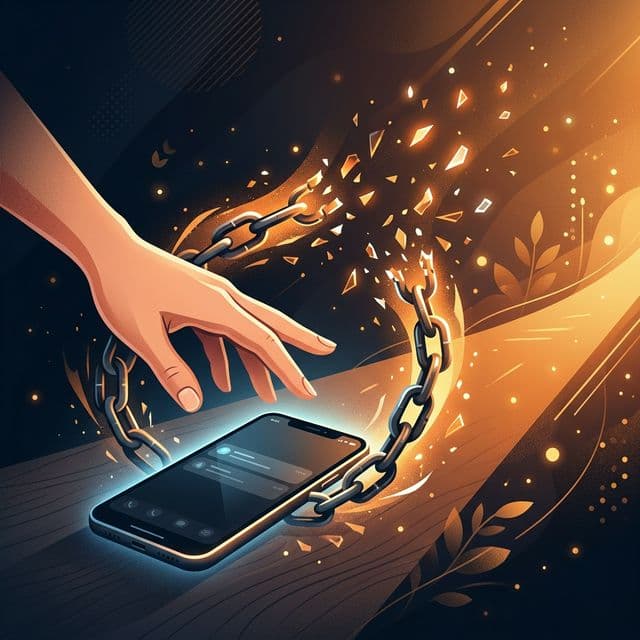
Your smartphone is the primary battleground. Here are specific strategies for minimizing its hold on your attention. First, remove all social media apps from your phone. If you must use social media, access it through a browser on your computer during designated times. Second, turn off all notifications except calls and messages from important contacts. Third, use grayscale mode to make your screen less visually appealing. Fourth, move your phone charger out of the bedroom. Fifth, use an app blocker or digital detox tool to enforce boundaries.
RepUnlock offers a uniquely minimalism-friendly approach to phone management. Rather than relying on willpower to resist checking blocked apps, it requires physical exercise to unlock them. This transforms mindless scrolling impulses into health-promoting activity — a perfect alignment with minimalist values of intentionality and physical wellbeing.
Social Media
Social media deserves special attention because it is designed specifically to be addictive. Digital minimalists typically take one of three approaches: complete abstinence (deleting all accounts), radical reduction (keeping one platform with strict usage rules), or scheduled use (checking social media only during designated daily windows).
If you choose to keep any social media, aggressively curate your feeds. Unfollow anyone who does not add genuine value to your life. Turn off all notifications. Remove the app from your home screen. Set a daily time limit. And most importantly, never use social media as a default activity when you are bored — boredom is not a problem to be solved with scrolling.
For a deeper look at cutting back on social platforms, visit our social media detox guide.
Email and Messaging
Email is often mistaken for an urgent communication tool when it is actually an asynchronous one. Digital minimalists batch their email processing into two or three daily sessions rather than monitoring the inbox continuously. Remove email from your phone if possible, or at minimum disable notifications.
For messaging apps, designate specific contacts as important (family, close friends, work emergencies) and mute or leave group chats that do not serve a clear purpose. The goal is to communicate intentionally rather than reactively.
News and Information
The 24/7 news cycle is a significant source of anxiety and attention fragmentation. Digital minimalists typically limit news consumption to one or two trusted sources, consumed at a set time (such as reading a morning newspaper or weekly news digest). Push notifications for breaking news are eliminated entirely. Almost nothing in the news requires your immediate attention.

Minimalism decides what stays on the phone. Volt decides what it costs to open — one rep, one minute, and the apps that survived the declutter still have to be earned.
Get RepUnlockDigital Minimalism for Students
Students face unique challenges because technology is deeply integrated into education. The key is separating productive digital use (research, collaboration, learning tools) from distracting digital use (social media, entertainment, gaming).
Practical strategies include using website blockers during study sessions, keeping the phone in another room while studying, using paper notebooks for note-taking when possible, and scheduling specific times for recreational phone use. An app blocker that requires exercise to unlock distracting apps can be particularly effective for students — the brief physical activity provides a study break while preventing the 45-minute social media rabbit hole.
The Study Environment
Digital Minimalism for Families
Implementing digital minimalism as a family requires conversation, agreement, and modeling. Children learn technology habits primarily from watching their parents. If you want your children to have a healthy relationship with screens, demonstrate one yourself.
Create phone-free zones (dining table, bedrooms) and phone-free times (meals, first hour of the day, last hour before bed). Establish family activities that do not involve screens. Have open conversations about why you are making these changes — children respond better to understanding the reasoning than to arbitrary rules.
Common Objections and Responses
“I will miss important things.”
This is FOMO talking. In reality, very little on social media is genuinely important. Anything truly important — a friend’s engagement, a family emergency, a major world event — will reach you through direct communication channels. You will not miss what matters.
“I need social media for work.”
If social media is genuinely part of your job (you are a social media manager, content creator, or marketer), then it is not optional — it is a work tool. Treat it accordingly: use it during work hours for work purposes, and do not let it bleed into personal time. Use separate work and personal accounts if necessary.
“I do not have the willpower.”
Digital minimalism is not about willpower. It is about designing your environment so that willpower is not necessary. Remove apps, turn off notifications, use blockers, charge your phone in another room. If willpower is your concern, tools like RepUnlock are specifically designed to work when willpower fails — you physically cannot access blocked apps without doing the exercise. The same substitution runs underneath a phone-free morning routine: the cue arrives either way, so something has to be waiting in the feed’s place.
Environment Design Over Willpower
Tools That Support Digital Minimalism
While digital minimalism is primarily a philosophy, the right tools make implementation much easier. RepUnlock is ideal for gating access to addictive apps behind physical exercise. A phone detox toolkit can help structure your declutter period. Grayscale mode reduces the visual appeal of your screen. Physical alarm clocks eliminate the need to keep your phone by the bed. Paper notebooks provide screen-free alternatives for notes and journaling.
The irony of using technology to reduce technology use is not lost on digital minimalists. The key is that these tools are means to an end, not ends in themselves. Use them to establish new habits, then gradually reduce reliance on them as the habits become automatic.
Starting Today
You do not need to overhaul your entire digital life overnight. Start with one change. Turn off social media notifications today. Delete one app you have not used in a month. Charge your phone outside the bedroom tonight. Each small step builds momentum toward a more intentional digital life.
If you want a structured starting point, download RepUnlock and block your three most-used distracting apps. The exercise requirement will immediately make you more conscious of how often you reach for your phone — and every time you do, you will get healthier instead of more distracted. That is digital minimalism in action: transforming a harmful habit into a beneficial one.
The goal of digital minimalism is not to use less technology. It is to use technology less mindlessly. When every interaction with your phone is intentional, you stop being a product of the attention economy and start being the author of your own attention. That shift changes everything.