The phone addiction statistics for 2026 that matter are not the hours — they are the costs. Heavy users at five hours a day are 35% more likely to be diagnosed with generalized anxiety disorder, 67% check a phone that has not buzzed, and the average person underestimates their own usage by more than half.
What follows is the cost side of the ledger, drawn from peer-reviewed research, industry reports and large-scale surveys: mental health, sleep, attention, money, and the self-awareness gap underneath all of it.
How Much, Briefly
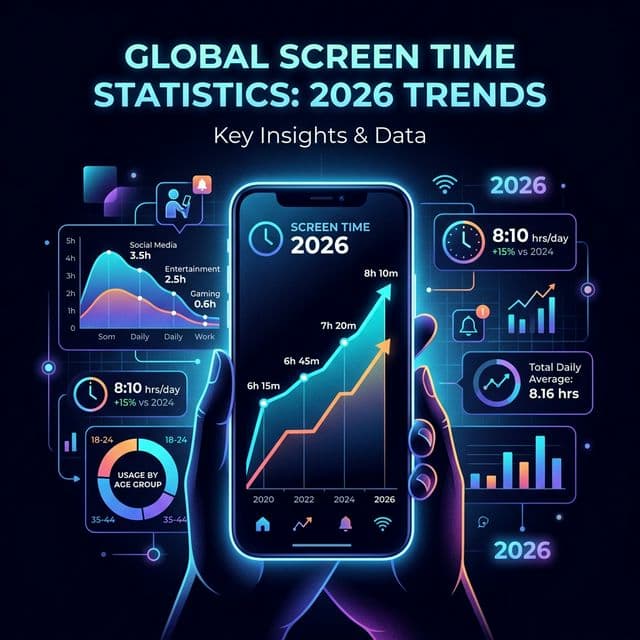
The average adult spends roughly 7 hours 12 minutes a day on screens, with about 4 hours 37 minutes of that on a phone — approximately 1,685 hours a year, or over 70 full days. The full breakdown by age, country and app category lives on our average screen time page; this page is about what those hours take from you.
Pickups and Checks
The average smartphone user picks up their phone 144 times per day in 2026, up from 96 times in 2022. Each pickup averages 1 minute and 55 seconds, though social media sessions tend to last significantly longer. The most frequent pickup times are immediately upon waking (89% of users), during meals (72%), and in bed before sleep (94%).
Perhaps more telling is the statistic on compulsive checking: 67% of smartphone users report checking their phone even when it has not buzzed or displayed a notification. This phantom checking behavior is a hallmark of addictive use patterns.
Demographics: Who Is Most Affected?
Age Groups
Gen Z (ages 14-27) leads all demographics with an average of 5 hours and 52 minutes of daily smartphone use. Millennials (ages 28-43) follow at 4 hours and 38 minutes. Gen X (ages 44-59) averages 3 hours and 47 minutes, while Baby Boomers (ages 60-78) average 2 hours and 51 minutes.
The teenage subset of Gen Z is particularly concerning. Teens aged 13-17 average 6 hours and 40 minutes of daily phone use outside of school-related activities. This is higher than the time they spend sleeping on school nights in many surveys.
The Youth Crisis
Geographic Patterns
Phone usage varies significantly by region. Southeast Asian countries lead globally, with the Philippines, Thailand, and Indonesia averaging over 5 hours and 30 minutes daily. The United States averages 4 hours and 49 minutes, while European countries tend to be slightly lower, with Germany at 3 hours and 41 minutes and France at 3 hours and 58 minutes.
Interestingly, countries with higher smartphone penetration do not always have higher usage times. Japan and South Korea, despite being among the most digitally connected nations, average moderate smartphone times of 3 hours and 45 minutes and 4 hours and 2 minutes respectively, suggesting that cultural factors play a significant role.
Social Media: The Primary Driver
Social media remains the single largest category of smartphone usage, accounting for approximately 2 hours and 24 minutes of the average person’s daily phone time. This is roughly 52% of total smartphone usage. The most time-consuming platforms in 2026 are TikTok (averaging 58 minutes per session), YouTube (48 minutes), Instagram (38 minutes), and X/Twitter (27 minutes).
The addictive design of these platforms is well-documented. Infinite scroll, variable reward schedules, social validation through likes and comments, and algorithmically personalized content all exploit the same dopamine pathways that drive substance addiction. The difference is that the substance is in your pocket 24 hours a day.
The Dopamine Connection
Mental Health Impact
Anxiety and Depression
A 2026 meta-analysis of 47 studies involving over 250,000 participants found a significant positive correlation between daily smartphone usage exceeding 4 hours and increased rates of anxiety and depression. The relationship was strongest among adolescents and young adults.
Specifically, heavy phone users (5+ hours daily) were 35% more likely to be diagnosed with generalized anxiety disorder and 28% more likely to be diagnosed with major depressive disorder compared to moderate users (2-3 hours daily). While correlation does not prove causation, the consistency of findings across multiple studies and populations is compelling.
Sleep Disruption
The impact on sleep is perhaps the most well-established health consequence of excessive phone use. In 2026, 71% of adults report using their phone within 30 minutes of bedtime, and 42% report using their phone in bed until they fall asleep. These behaviors are associated with delayed sleep onset (averaging 23 minutes longer to fall asleep), reduced sleep quality, and shorter total sleep duration.
Blue light exposure from screens suppresses melatonin production, but researchers now believe the content itself is equally problematic. Engaging, stimulating content keeps the brain in an alert state, making the transition to sleep more difficult regardless of blue light filters. We unpack that in detail in screen time and sleep.
The 90-Minute Rule
Attention Span and Cognitive Performance
Research from 2025-2026 shows that the average human attention span for a single task has dropped to approximately 47 seconds, down from 2.5 minutes in 2004. While smartphones are not the sole cause, they are a primary contributor. The constant availability of novel stimulation trains the brain to expect frequent context switches.
A controlled study found that simply having a smartphone visible on a desk (even when turned off) reduced working memory capacity and fluid intelligence by a measurable amount. The mere presence of the device occupies cognitive resources as the brain allocates attention to resist checking it.
Physical Health Consequences
Excessive phone use contributes to a range of physical health issues. Text neck — the forward head posture caused by looking down at a phone — affects an estimated 58% of regular smartphone users, leading to chronic neck and upper back pain. Digital eye strain from prolonged screen viewing affects approximately 65% of adults, causing headaches, blurred vision, and dry eyes.
Perhaps most significantly, the sedentary nature of phone use contributes to physical inactivity. The average person’s 4+ hours of daily phone time is almost entirely sedentary. This is where solutions like RepUnlock offer a unique intervention — converting sedentary phone-checking impulses into brief exercise bursts throughout the day.
Sedentary Screen Time is the Real Killer
Economic Impact
Phone addiction has measurable economic consequences. Workplace productivity losses from smartphone distractions are estimated at $997 billion globally in 2026. The average employee checks their phone 56 times during work hours, with each interruption requiring an average of 23 minutes to fully regain focus on the original task.
Students are similarly affected. College students who use their phones during lectures score an average of 17% lower on exams covering the material presented. The cumulative GPA impact is estimated at 0.3-0.5 points for heavy phone users compared to moderate users.
The Self-Awareness Gap
One of the most troubling statistics is the gap between perceived and actual phone usage. When asked to estimate their daily phone time, the average person guesses approximately 2 hours and 15 minutes — less than half of their actual usage of 4 hours and 37 minutes. This self-awareness gap makes it difficult for people to recognize they have a problem.
Furthermore, 87% of people believe they have a healthy relationship with their phone, yet 62% of the same people report feeling anxious when separated from their device for more than an hour. This disconnect between perception and reality is characteristic of addictive behaviors.
Check Your Real Numbers

What Is Being Done: Solutions and Trends
Awareness of phone addiction has driven a growing market for digital wellness solutions. The app blocker and digital detox market is projected to reach $4.8 billion by 2027, up from $1.2 billion in 2023. Governments in several countries have implemented or proposed regulations around addictive app design, particularly for minors.
On the individual level, the digital detox movement continues to grow. Sales of basic phones (non-smartphones) increased 23% year-over-year in 2025, suggesting that some consumers are seeking radical solutions. However, most people prefer to manage their smartphone use rather than abandon it entirely.
This is where smart tools make the difference. Rather than eliminating the smartphone — which is impractical for most modern lives — apps like RepUnlock change the relationship between user and device. By introducing physical effort as a gateway to distracting apps, they create the friction that addictive app design intentionally eliminates.
Taking Action
The statistics are clear: phone addiction is widespread, worsening, and harmful. But statistics alone do not change behavior — tools and habits do. Here are evidence-based steps you can take today.
First, establish baseline awareness by checking your actual Screen Time data. Second, identify your top three most-used distracting apps. Third, implement a blocking or gating system for those apps. Fourth, create phone-free zones (bedroom, dining table) and phone-free times (first hour of the day, last hour before bed). Fifth, replace phone time with intentional activities like exercise, reading, or face-to-face conversation.
If you want those five steps as an actual plan rather than a list, our guide to breaking phone addiction walks through the timeline. And if you are ready to take the most impactful single step, try an exercise-based phone addiction solution like RepUnlock. It addresses the core problem — compulsive app checking — while simultaneously improving your physical health. In a world where the average person spends 70 days per year on their phone, even a 30% reduction frees up 21 days of your life annually.